Guide For home
Protect your family from AI voice-clone scam calls
A familiar voice isn't proof an emergency call is real. Make a callback plan, pick a private family phrase, and know who to contact if money was sent.
What this guide does
- You'll end up with
- a family code word everyone knows by heart, a backup question, and a one page plan to print.
- Time
- About 20 minutes (our rough guess, not a timed test)
- You'll need
-
- Your phone and a private place to make a family plan
- Trusted contact numbers you already know
If the call is happening now: hang up and call your loved one on a number you already trust. Don't let the caller pick the person or number that will "confirm" the story. If someone is in immediate danger, call local emergency services yourself.
You don't need to work out whether the voice is fake first. What matters is whether you can check the person and the request on your own.
Step 1 of 5
Pick a family code word
Agree on it in person. Never post it, text it or write it down.
Make your plan with this prompt: Family code word plan. It helps you pick a word, teach it to grandparents and kids, and print a one page plan.
The FBI recommends a family word or phrase to confirm who you're talking to. Agree on it in private, and pick something nobody could guess from your family's public posts. Make sure everyone who will use it knows the plan.
Don't write the phrase on your contact note, in case the note gets lost. Don't type it into an AI chat or post a photo of it. Even if a caller gets it right, still watch for other warning signs and still call back on a number you trust. If you think the phrase has leaked, pick a new one in private.
Watch out: never type your real code word into any AI chat, this prompt included. The prompt never asks for it.
Step 2 of 5
Don't trust the voice
A copied voice can sound exactly right, and caller ID can be faked.
The FTC warns that a scammer can copy a loved one's voice from a short recording posted online. Its advice: call the person on a number you know, or reach them through another relative or friend.
The story might be an accident, an arrest or a trip gone wrong. The FTC's family-emergency guidance describes the pressure: act fast, keep it secret, or trust someone pretending to be an official. A caller who knows personal details can still be lying.
This guide turns that advice into a plan your family can make together. The wording and contact note below are our suggestions. No single check will catch every scam.
Reduce what strangers can collect
The FBI's guidance suggests limiting the voice clips and photos you post publicly and keeping social media accounts private. Sit down together and check who can see your posts. Ask whether recordings, location clues and who is related to whom really need to be public.
Privacy settings make you harder to target, but they don't make any call trustworthy. Don't blame a relative for sharing a video. The goal is a plan everyone will use, including whoever feels embarrassed about a suspicious call.
Step 3 of 5
Hang up and call back
Use the number saved in your phone, never one the caller gives you.
For each close relative, pick the number you'd use to reach them, plus a backup person who might know where they are. Agree that nobody will be upset if someone double-checks a scary request. That makes it easier to break the pressure of a frightening call.
Try saying this (our wording):
I want to help. I am going to end this call and check on you through our usual contact route.
Say it out loud once to practice. You don't have to argue with the caller or explain how you're checking. If the first person doesn't answer, try your backup. A call that goes unanswered doesn't prove it's a scam, or that it's real.
Make your own contact note
You don't need another article or a downloadable card. Copy this into a private note on your phone or onto paper. Leave out account numbers, passwords and the family phrase.
Scroll to see every column
| Contact | Name | Trusted number or route |
|---|---|---|
| Person I would check on first | Fill in privately | Fill in privately |
| Backup relative or friend | Fill in privately | Fill in privately |
| Another trusted person nearby | Fill in privately | Fill in privately |
| Bank or card provider | Provider name | Use the card, statement or official app |
Add a reminder at the top: Check on your own before paying. Update it when someone's number changes. Ask each person where they'll keep their copy, so they can find it in a stressful moment instead of digging through an old chat.
Step 4 of 5
Never pay in a rush
A payment app, wire, gift cards, money orders or cash handed over in person are signs to stop and check.
The FTC's voice-cloning advice says an urgent request to wire money, buy gift cards or send cryptocurrency is a warning sign. Don't pay while you're still checking who is calling.
The caller might switch from a family emergency to a story about your bank or an account. The FTC's guidance on unexpected financial calls says to contact the bank or company yourself, using its official app, its website, a recent statement or the back of your card. It also warns against trusting a phone number from a paid search result. Keep verification codes to yourself, and never give a stranger remote access to your device.
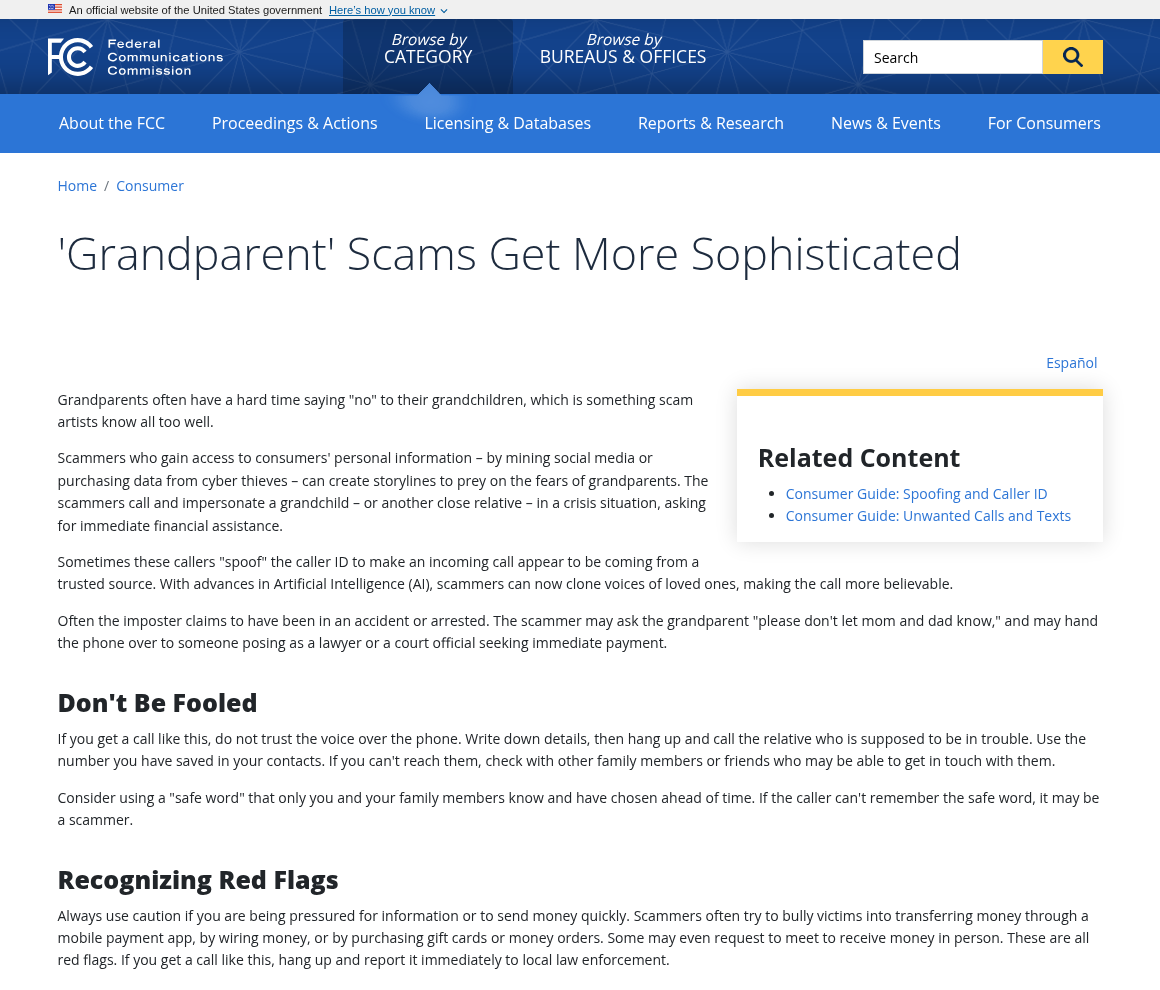
The FCC says scammers may ask you to pay with a payment app, a wire transfer, gift cards or money orders, or to hand cash to someone in person. Any of those is a reason to stop and check. The FCC's advice: don't trust the voice on the phone. Write down the details, hang up, and call your relative on the number saved in your contacts.
Step 5 of 5
Practice once, then report
Run a 2-minute drill every few months. Report scam calls at ReportFraud.ftc.gov and ic3.gov.
Take turns reading out a made-up urgent request. The other person practices hanging up, finding the contact note and choosing the backup person. Don't fake a real crisis without warning everyone involved. Make it clear it's practice.
The goal is simple: everyone knows how to check a worrying request, where their trusted numbers are, and who can help if something goes wrong.
If money or information was already shared
Contact the company you used to send the money right away. The FTC's recovery guide has steps for banks, payment apps, card companies, wire services, gift cards and cryptocurrency. Tell them you were tricked and ask if the payment can be reversed or refunded. You may not get the money back.
Keep receipts, gift cards and payment records, plus any messages and the time of the call. If you gave out a password, change it, and change it anywhere else you used it. If you shared identity details, follow the steps in the FTC guide instead of guessing what to fix first.
Report it at ReportFraud.ftc.gov and to the FBI's IC3. Tell someone you trust what happened so you have help following up. You don't need to understand the technology to ask for help.
Checklist
- Family code word picked in person, never written in a chat or on paper
- Everyone knows: hang up and call back on a saved number
- Contact list made (who to call first, a backup, your bank's number from your card)
- Practice run done, next one on the calendar
- Everyone knows where to report: ReportFraud.ftc.gov and ic3.gov
Prompts in this guide
Try it: Our family code word plan
Set up a family code word against voice-clone calls, with a teaching script for each group and a one-page printout.
Copy and paste
FILL THIS IN (then copy everything into your AI chat)
Who I'll teach it to (the people who need the plan, like grandparents, kids or both): grandparents, kids
(Don't write your code word anywhere in this prompt.)
--- Don't change anything below this line ---
You are a calm family safety coach. Help me set up a family code word plan against fake emergency calls that use a copied voice, one the people in "Who I'll teach it to" will actually remember and use. Do NOT ask me for our actual code word. Don't suggest example code words or example backup questions; I'll pick my own.
Give me:
1) 5 rules for picking a good code word (easy to remember, hard to guess, not a pet's name or anything on social media).
2) A short script for teaching it in person, written separately for each group in "Who I'll teach it to", in words that fit that group. Under 100 words each.
3) If someone forgets the word under stress: how to pick one backup question only real family could answer (don't suggest one), and the rule that it's still fine to hang up and call back.
4) What to do if a call feels off, as 4 short steps: don't send money, gift cards or codes; hang up; call back on a number already saved in my phone; tell the family.
5) A 2-minute practice drill we can run in a few months so nobody forgets, and how to change the word if it ever gets shared.
6) A one-page plan I can print, with blanks for the people to call back and their saved numbers. Keep the code word and the backup answer off the printed page; they're memorized, never written down.
Keep it calm and simple. No scam statistics. Stop after part 6; don't offer extra files or follow-ups.
Example result
We filled in: Who I'll teach it to: grandparents, kids.
Family Emergency Code Word Safety Plan
A family code word helps protect everyone if a scammer calls pretending to be a grandparent, child, or another family member using a copied voice.
The goal is simple: pause, verify, and call back before doing anything.
1. Five rules for choosing a good code word
- Make it easy to remember. Choose something everyone can say and remember, even when scared or upset.
- Make it hard to guess. Avoid common words, birthdays, addresses, and obvious family references.
- Keep it private. Don't post it on Facebook, Instagram, or other social media.
- Don't use a pet's name. Scammers might find pet names through online photos and posts.
- Choose something unusual. Avoid words that could easily come up in normal conversations.
Everyone who needs to know should memorize it. Never send it in a text message or write it somewhere others can find it.
2. Teaching scripts
For grandparents
"Sometimes people can make a phone call sound like someone we love. Even if you recognize a voice, it doesn't always mean it's really them. Our family has a special secret word. If someone calls saying there's an emergency, ask them for the word. Never rush to send money or share information. If something feels strange, hang up and call us using the number already saved in your phone. It's always okay to double-check."
For kids
"Sometimes bad people pretend to be someone in our family on the phone. They might even sound like someone you know. That's why our family has a secret word. If someone calls and says there's an emergency, ask for our secret word. Never send money, share passwords, or follow scary instructions. If you're unsure, hang up and call a trusted grown-up. You will never get in trouble for checking first."
3. If someone forgets the word
Have one backup question that only genuine family members could reasonably answer.
Choose a question that:
- Has an answer known to the real family.
- Isn't answered by social media or public information.
- Isn't easily guessed by someone who knows basic family details.
- Has one clear answer.
- Everyone can remember how to ask.
Important: Don't create several backup questions. Choose just one and keep its answer memorized.
If someone cannot remember the code word or answer, that's okay.
It's always fine to hang up and call the family member back using a number already saved in your phone.
4. What to do if a call feels off
- Don't send anything. Never send money, gift cards, passwords, or verification codes because of an urgent phone call.
- Hang up. Don't let someone pressure you into staying on the phone.
- Call back. Use a phone number already saved in your contacts, not a number the caller gives you.
- Tell the family. Let everyone know about the suspicious call so others can be careful too.
5. Two-minute family practice drill
Repeat this practice in a few months to keep everyone comfortable with the plan.
Minute 1: Practice the call
- One person pretends to make an emergency call.
- The other person practices asking for the family code word.
- Practice staying calm and not rushing.
- Try a second round where the caller doesn't know the word.
Minute 2: Practice the response
- Pretend the caller is pressuring someone to send money.
- Practice hanging up.
- Practice calling back using a saved contact.
- Practice telling another family member what happened.
Remind everyone that they are never in trouble for hanging up and checking.
If the code word is ever shared:
- Stop using the old word immediately.
- Tell everyone in the family that it needs changing.
- Choose a completely new private word.
- Teach the new word in person or through a trusted, private conversation.
- Make sure everyone memorizes the replacement.
Never announce the new word publicly or put it in a group text.
6. Printable one-page family plan
OUR FAMILY SAFETY PLAN
Stop. Check. Call back.
OUR FAMILY RULES
- We never rush because someone says there is an emergency.
- We verify unexpected emergency calls.
- We never send money, gift cards, or verification codes because of a phone call.
- We can always hang up and check with another family member.
- Nobody gets in trouble for being careful.
PEOPLE TO CALL BACK
\_\_\_\_\_\_\_\_\_\_\_\_\_\_\_\_\_\_
- Saved phone number
- \_\_\_\_\_\_\_\_\_\_\_\_\_\_\_\_\_\_
\_\_\_\_\_\_\_\_\_\_\_\_\_\_\_\_\_\_
- Saved phone number
- \_\_\_\_\_\_\_\_\_\_\_\_\_\_\_\_\_\_
\_\_\_\_\_\_\_\_\_\_\_\_\_\_\_\_\_\_
- Saved phone number
- \_\_\_\_\_\_\_\_\_\_\_\_\_\_\_\_\_\_
\_\_\_\_\_\_\_\_\_\_\_\_\_\_\_\_\_\_
- Saved phone number
- \_\_\_\_\_\_\_\_\_\_\_\_\_\_\_\_\_\_
\_\_\_\_\_\_\_\_\_\_\_\_\_\_\_\_\_\_
- Saved phone number
- \_\_\_\_\_\_\_\_\_\_\_\_\_\_\_\_\_\_
IF A CALL FEELS STRANGE
- Don't send money, gift cards, or codes.
- Hang up.
- Call back using a saved phone number.
- Tell the family.
OUR FAMILY AGREEMENT
We will protect each other by checking first, staying calm, and never letting someone pressure us into making a quick decision.
Practice date: \_\_\_\_\_\_\_\_\_\_\_\_\_\_\_\_\_\_
Next practice date: \_\_\_\_\_\_\_\_\_\_\_\_\_\_\_\_\_\_
Family members who have learned the plan:
1.
2.
3.
4.
5.
KEEP THE CODE WORD AND BACKUP ANSWER MEMORIZED. NEVER WRITE THEM ON THIS PAGE.

Questions
Do I need to prove the voice was generated by AI?
No. Check the person and the story another way, like calling back on a number you trust. You don't need to know what technology the caller used.
Is a family phrase enough?
It helps, but it's not a guarantee. If the request is unusual or urgent, call back on a number you trust as well.
Do I need to buy an identity-protection service?
No. You can make this plan without one. This guide doesn't review or recommend any paid service.
The call showed my grandson's number. Doesn't that prove it's him?
No. The FCC warns that scammers can fake (spoof) caller ID. Hang up and call back on the number saved in your phone.